
Tennis scoring confuses almost every newcomer, with its "love", "deuce" and numbers that jump from 15 to 30 to 40. This guide explains how points build into games, games into sets and sets into matches, how tie-breaks and final-set rules work, and how serving and changing ends fit into the structure.
The structure in one sentence
A tennis match is built from three layers. Players win points to win a game, win games to win a set, and win sets to win the match.
Most professional matches are played as the best of three sets, so the first player to win two sets wins. At the four Grand Slam tournaments, men's singles matches are played as the best of five sets, so the first player to three sets wins.
The scoring layers are independent. The point score resets to zero at the start of every game, and the game score resets at the start of every set.
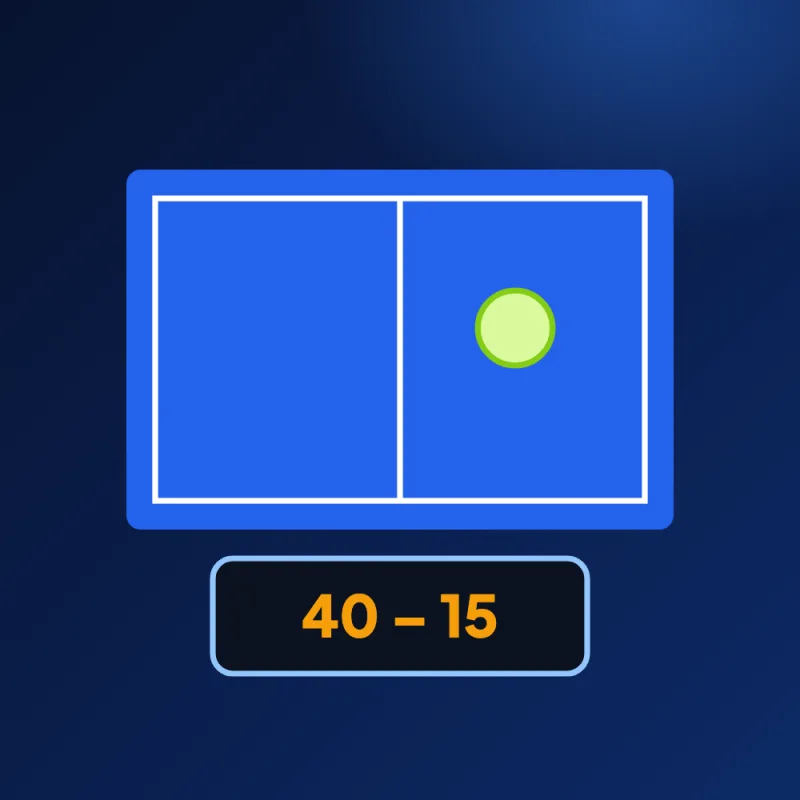
Scoring points within a game
Points within a game are not counted as 1, 2, 3. Instead they use traditional terms:
| Points won | What the umpire calls |
|---|---|
| 0 | Love |
| 1 | 15 |
| 2 | 30 |
| 3 | 40 |
| 4 (with a lead of two) | Game |
The server's score is always called first. So "30-15" means the server has won two points and the receiver one. "15-30" means the receiver is ahead, even though the umpire is describing the same kind of game.
When both players are level at 15 or 30, the score is called "15-all" or "30-all". The origins of the 15-30-40 sequence are not known for certain, and historians have offered several theories.
Deuce and advantage
A game must be won by two clear points. If both players reach 40, the score is called deuce.
From deuce, the next player to win a point has the advantage. If the server wins it, the umpire calls "advantage" followed by the server's name; if the receiver wins it, it is the receiver's advantage. The player with the advantage wins the game by taking the next point. If they lose it, the score returns to deuce.
Example. From 40-40, the server wins a point: advantage server. The receiver wins the next: deuce again. The server then wins two in a row: game to the server. In theory a game can go to deuce any number of times.
Some formats, particularly doubles on the professional tours, use no-ad scoring instead. At deuce a single deciding point is played, and the receiving side chooses which side of the court to receive from. Whoever wins that point wins the game.
Winning a set
A set is won by the first player to win six games, provided they lead by at least two. So 6-4 or 6-2 ends a set, but 6-5 does not.
If the score reaches 5-5, the set continues. A player can win it 7-5. If it reaches 6-6, a tie-break is normally played to decide the set, and the set is recorded as 7-6.
A few terms are worth knowing:
- Hold. The server wins their own service game.
- Break. The receiver wins the game. Because serving is an advantage, a break is usually the key moment in a set.
- Break point. The receiver is one point from winning the game, for example at 30-40 or at advantage receiver.
- Set point and match point. A player is one point from winning the set or the match.
How the tie-break works
The standard tie-break is played to 7 points, and it must be won by two clear points. Points are counted in ordinary numbers: 1, 2, 3 and so on. If the score reaches 6-6 in the tie-break, play continues until someone leads by two, such as 9-7.
The serving order in a tie-break is distinctive:
- The player whose turn it is to serve serves the first point from the right-hand side of the court.
- The opponent then serves the next two points, starting from the left side.
- After that, the players alternate, each serving two points in turn.
- Players change ends after every six points, for example at 4-2 or 3-3.
The player who served first in the tie-break receives in the first game of the next set. The winner of the tie-break wins the set 7-6, and the tie-break score is often shown in brackets, such as 7-6(5), meaning the loser of the tie-break scored five points.
A match tie-break, also called a super tie-break, is a longer version played to 10 points, again needing a two-point margin. It is often used instead of a full deciding set in professional doubles and in some team competitions.
Final-set rules at the Grand Slams
For many years, the four Grand Slams each handled a deciding set differently. Some played on without a tie-break until a player led by two games, which occasionally produced extremely long matches.
Since 2022, all four Grand Slam tournaments have used the same rule: if the final set reaches 6-6, a 10-point tie-break is played, won by two clear points. Before this, the individual tournaments had different rules, so historic scorelines such as 70-68 in a final set reflect the older formats.
Serving, faults, lets and changing ends
The same player serves for a whole game, and service alternates game by game. In a game, the first point is served from the right-hand side of the baseline, the next from the left, and so on, alternating each point.
The serve must land in the diagonally opposite service box. The server gets two attempts:
- A serve that misses the box, or that the server hits into the net, is a fault. The server then has a second serve.
- Two faults in a row is a double fault, and the receiver wins the point.
- A foot fault happens if the server touches the baseline or the court inside it before hitting the ball. It counts as a fault.
- A serve that touches the net and then lands in the correct box is a let, and that serve is replayed without penalty.
An ace is a legal serve that the receiver does not touch at all.
Changing ends and breaks
Players change ends after the first, third, fifth and every following odd-numbered game of each set. This shares out the effects of wind and sun.
At most changeovers the players may sit for a short rest. There is no seated break after the first game of a set, or during a tie-break, where players simply swap ends and continue. Between sets there is a slightly longer set break.
If a set ends after an odd number of games, such as 6-3, the players change ends before the next set begins. If it ends after an even number, such as 6-4, they stay where they are for the first game of the next set, then change after it.
Reading a scoreline
A completed match score lists the games in each set from the winner's point of view. For example, 6-4, 3-6, 7-6(4) means:
- The winner took the first set six games to four.
- The loser took the second set six games to three.
- The winner took the third set in a tie-break, in which the loser scored four points.
A score such as "6-0" is sometimes called a bagel, and "6-1" a breadstick. Both are informal terms you will hear in commentary.
Key points
- Points within a game go love, 15, 30, 40, then game, with the server's score called first.
- At 40-40 it is deuce, and a player must win two points in a row to take the game.
- A set goes to six games with a two-game lead, with a 7-point tie-break at 6-6.
- In a tie-break, one player serves the first point, then players alternate every two points and change ends every six points.
- Since 2022 the Grand Slams have used a 10-point tie-break at 6-6 in the final set.
- Two faults in a row lose the point, while a let on serve is replayed.


