
Badminton is fast to watch but easy to understand once you know how the score moves and where each player must stand to serve. This guide explains the rally-point scoring system, the rules of serving in singles and doubles, the court lines, and the most common faults, with examples you can apply to any match.
The basics of a badminton match
Badminton is played with racquets and a shuttlecock, also called a shuttle or birdie, over a net. A match can be singles, with one player per side, or doubles, with two. Doubles is played as men's doubles, women's doubles and mixed doubles.
The aim is simple: hit the shuttle over the net so that it lands inside your opponent's court, or force them into an error. Unlike tennis, the shuttle must not bounce. A rally ends as soon as the shuttle touches the floor, hits the net and drops on the hitter's side, or goes out.
The laws are set by the Badminton World Federation (BWF), which governs the sport internationally.
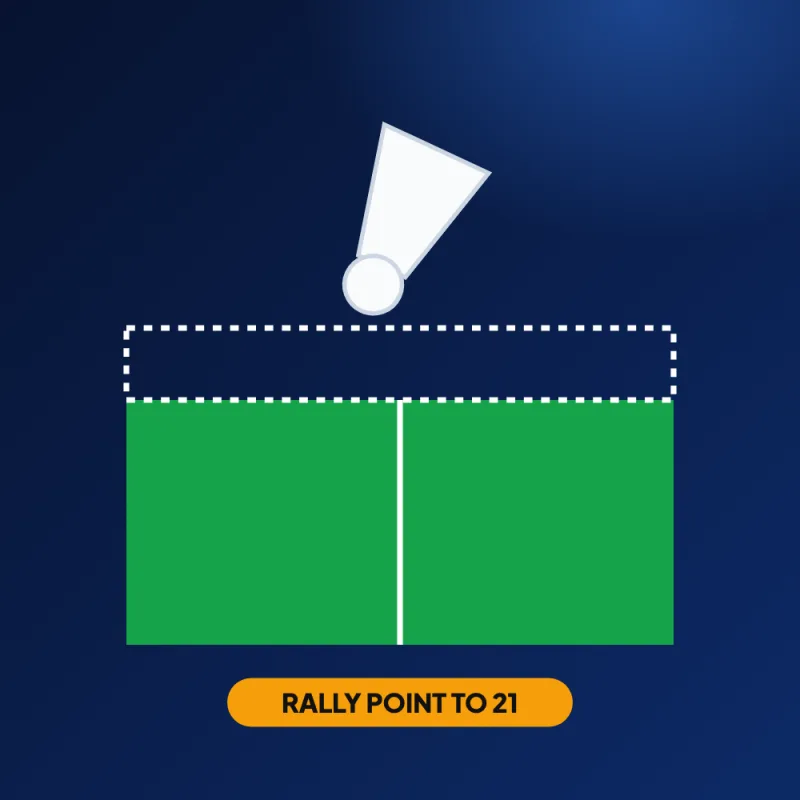
How scoring works
Badminton uses rally-point scoring. A point is won on every rally, whichever side served. The current system has been used in international play since 2006, when it replaced an older format in which only the serving side could score.
The main rules are:
- A match is the best of three games.
- Each game is played to 21 points.
- A game must be won by two clear points. If the score reaches 20-20, play continues until one side leads by two, such as 22-20 or 25-23.
- There is a cap. If the score reaches 29-29, the side that wins the next point wins the game 30-29.
- The side that wins a rally serves the next point.
Example. A player leading 20-18 needs one more point. If the opponent wins the next three rallies, the score becomes 20-21, and now the opponent needs one point to win 22-20.
The BWF has discussed alternative scoring formats, such as shorter games, over the years. The 21-point, best-of-three system described here is the long-established standard.
Intervals and changing ends
Matches include short breaks at fixed moments:
- When the leading side reaches 11 points in a game, there is an interval of up to 60 seconds.
- Between games there is an interval of up to two minutes.
- Players change ends after each game, and in the third game they change ends again when the leading side reaches 11.
Changing ends matters because conditions in a hall are rarely identical. Air conditioning drafts and lighting can make one side faster or harder to see, so the rule keeps the contest fair.
The court and its lines
A full badminton court is 13.4 metres long and 6.1 metres wide. The net is 1.55 metres high at the posts and slightly lower, 1.524 metres, at the centre. The lines are part of the court, so a shuttle landing on any part of a line is in.
The confusing part for new fans is that singles and doubles use different boundaries, and serving uses different boundaries again from open play.
| Situation | Side boundary | Back boundary |
|---|---|---|
| Singles serve | Inner (singles) side line | Outer back line |
| Singles rally | Inner (singles) side line | Outer back line |
| Doubles serve | Outer (doubles) side line | Inner long service line for doubles |
| Doubles rally | Outer (doubles) side line | Outer back line |
A simple way to remember it: singles is long and narrow, doubles serving is short and wide. Once the serve has been returned in doubles, the full court is in play.
Near the net, the short service line marks the front of the service courts. A serve must travel past it to be good.
Serving rules
Every rally begins with a serve hit diagonally into the opponent's service court. The serve is tightly controlled to stop the server from gaining an unfair attacking advantage.
Where the server stands depends on the score. The server serves from the right service court when their score is even (0, 2, 4 and so on) and from the left service court when it is odd. The receiver stands in the diagonally opposite court.
The key technical requirements are:
- The whole shuttle must be below a set height when it is struck. At top level the BWF uses a fixed height of 1.15 metres above the court surface, measured with a device used by service judges, rather than the older waist-based rule.
- The racquet's movement must be continuous and forward once the serve starts. Pausing or feinting during the action is a fault.
- Both server and receiver must keep part of both feet on the floor, in a stationary position, until the serve is made.
- The server must hit the base of the shuttle, called the cork, first.
A serve that clips the net and still lands in the correct service court is good. There is no let for a net cord in badminton, unlike in tennis.
Serving in doubles
Doubles serving looks complicated, but it follows two rules: the score decides which court the serve comes from, and players only swap service courts when their side wins a point on its own serve.
Example. Side A leads 0-0 and serves from the right. If Side A wins the point, it is 1-0, and the same server moves to the left court to serve again. If Side B then wins the rally, it is 1-1, and the serve passes to Side B. Side B's players do not change position; whichever of them is standing in the left court, the correct court for an odd score, now serves.
Each side has only one server at a time. The serve passes between the sides as rallies are won and lost, rather than each partner taking a turn in sequence as in the old system.
Common faults
A fault ends the rally and gives the point to the opponent. The most common faults are:
- Shuttle out. It lands outside the boundary lines for that situation.
- Into the net. It fails to cross the net or passes through or under it.
- Touching the net. A player, their clothing or their racquet touches the net or its supports while the shuttle is in play.
- Reaching over. A player hits the shuttle before it has crossed to their side. A follow-through over the net is allowed once the shuttle has been struck on the player's own side.
- Double hit. The same player hits the shuttle twice in succession, or doubles partners hit it one after the other.
- Carry or sling. The shuttle is caught and held on the racquet and then slung, rather than struck cleanly.
- Body contact. The shuttle touches a player's body or clothing.
- Obstruction. A player distracts or obstructs an opponent, for example by shouting or making gestures.
Lets and officials
A let means the rally is replayed with no point awarded. Lets are called for unforeseen events, such as a shuttle from another court landing nearby, a receiver who was not ready when the serve was made, or the shuttle breaking apart during play.
At top-level events, the match is run by an umpire in a chair at the side of the net, supported by a service judge and line judges. Many international tournaments also use an electronic line-calling review system, where players have a limited number of challenges on line calls.
Key points
- Matches are best of three games; each game goes to 21 points with rally-point scoring.
- A game must be won by two points, with a cap at 30-29.
- There is a break at 11 points in each game and players change ends between games and at 11 in the decider.
- Serve from the right on an even score and the left on an odd score, diagonally and from below the set height.
- Singles uses the long, narrow court; doubles serving uses the short, wide court.
- The shuttle on the line is in, and there are no lets for net cords on serve.


