
The ICC rankings are the official league tables of international cricket, covering teams and individual players in Tests, One-Day Internationals and T20 Internationals. They are often quoted but rarely explained. This guide sets out how team ratings are calculated, why beating a strong side earns more than beating a weak one, how player ratings on the 0 to 1,000 scale work, and what the rankings do and do not measure.
What the ICC rankings are
The International Cricket Council publishes separate rankings for each of the three international formats, for both men's and women's cricket. There are two kinds:
- Team rankings, which rank national sides by a rating based on their results.
- Player rankings, which rank individual batters, bowlers and all-rounders on a points scale.
Both systems are calculated from match results and performances alone. There is no voting panel and no subjective judgement. A team or player rises by winning or performing well, especially against strong opposition, and falls by losing or performing poorly.
Since the ICC gave T20 International status to all of its members from 2019, the T20I team rankings include a very large number of countries, from the leading Test nations to developing associate sides.
How team ratings are calculated
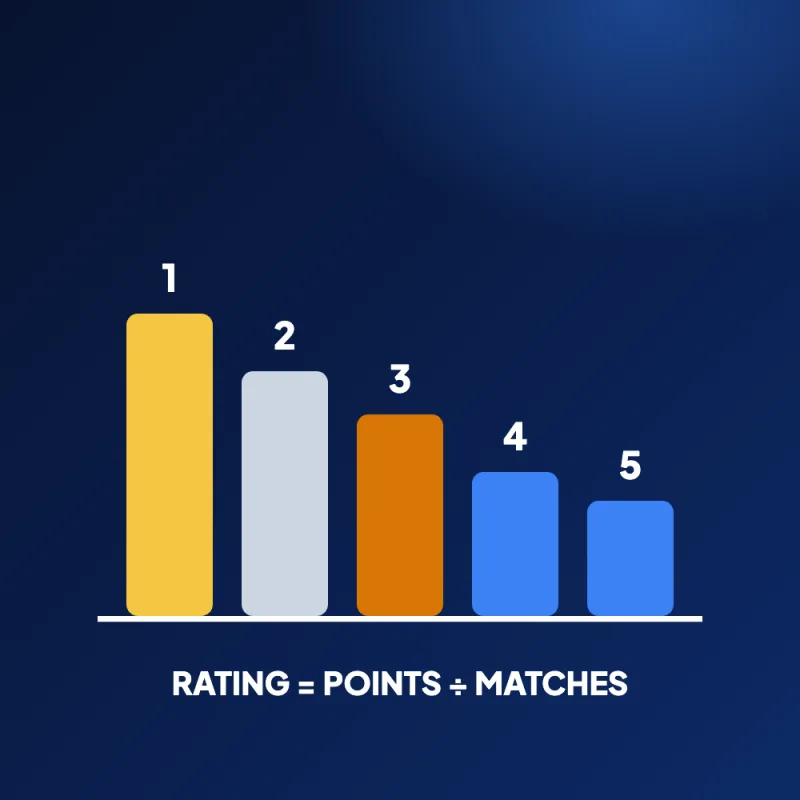
A team's rating is essentially an average. Each match a team plays earns it a certain number of ranking points. The rating is the total of those points divided by the number of matches played, with adjustments for how recent each match is.
Rating = total points ÷ number of matches (weighted by age)
Because it is an average, a team's rating reflects how well it performs per match, not how many matches it plays. A side that plays many fixtures does not gain an advantage simply from playing more often.
The rating is then rounded to a whole number, and teams are ranked from highest rating to lowest. When two teams have the same rounded rating, the one with the higher unrounded figure is placed above.
How points are earned in each match
The number of points a team earns from a match depends on the result and on the rating gap between the two sides before the game. This is what makes beating a strong team worth more than beating a weak one. Under the method the ICC has published for its team rankings, it works as follows.
| Situation | Winner earns | Loser earns |
|---|---|---|
| Ratings less than 40 points apart | Opponent's rating + 50 | Opponent's rating − 50 |
| Ratings 40 or more apart, stronger team wins | Own rating + 10 | Own rating − 10 |
| Ratings 40 or more apart, weaker team wins | Own rating + 90 | Own rating − 90 |
A drawn or tied match earns each team the opponent's rating when the sides are close, with a small adjustment in favour of the weaker team when they are far apart.
What this means in practice. When two evenly matched teams meet, the result swings both ratings. When a top side beats a much weaker one, it gains very little, because it was expected to win. When the weaker side causes an upset, it gains a lot and the stronger side loses some ground.
Test series bonus. In Test cricket, the series as a whole also counts. A team that wins a series earns bonus points on top of the points from individual matches, which reflects the importance of series in the Test format.
Weighting and the annual update
Team rankings cover a rolling period of roughly the last three to four years, not a team's entire history. Within that period, recent results count for more.
- Results from the most recent part of the period count at full weight.
- Results from the earlier part count at half weight.
- Results older than the full period no longer count at all.
Once a year, usually in May, the ICC carries out an annual update. The oldest year of results drops out of the calculation and the weighting shifts forward. This can cause noticeable movement in the tables without a ball being bowled, because a team that did well several years ago may lose those results while a team that has improved recently gains.
Between annual updates, the rankings change after each series or match as new results are added.
How player ratings work
Player rankings use a different system. Each player has a rating on a scale from 0 to 1,000, with separate lists for batting, bowling and all-rounders in each format.
After every match, a player's performance in that game is scored and blended into their existing rating. Recent matches carry the most weight, so a player's rating mainly reflects current form, while older performances fade gradually rather than dropping out all at once.
For batters, the calculation takes into account:
- runs scored,
- the strength of the bowling attack faced,
- the overall scoring level of the match, so runs on a difficult pitch count for more than runs in a high-scoring game,
- whether the team won,
- in white-ball formats, the scoring rate.
For bowlers, it considers:
- wickets taken, and the quality of the batters dismissed,
- runs conceded and, in white-ball formats, economy rate,
- the overall scoring level of the match,
- whether the team won.
All-rounder ratings combine a player's batting and bowling ratings, so a player must be strong in both disciplines to rank highly. Being outstanding in one and modest in the other produces a lower all-rounder rating than being very good at both.
New players. A player who has played only a few matches starts with a reduced rating, which rises to full value as they build up a record. This stops someone from topping the rankings after one excellent debut.
Reading the numbers
A player rating is easiest to understand in bands rather than as an exact figure. Ratings above 900 are rare and represent outstanding, sustained performance. Ratings in the 700s and 800s generally indicate a player in the world's top group. The precise thresholds vary by format and over time, so the ranking position often tells you more than the number itself.
Team ratings work similarly. A gap of a few points between two teams is small and can change with a single result, while a gap of 15 or 20 points usually reflects a clear difference in recent results.
Inactive players. Players who stop playing a format gradually drop out of the published lists after a period of inactivity, even though their historical ratings remain on record.
What the rankings do and do not measure
The rankings are a reliable guide to recent results, but they have limits.
Uneven schedules. Teams do not all play each other equally often. The points system adjusts for opponent strength, but a side that has played mostly at home, or mostly against weaker teams, may still be rated slightly differently from how it would fare against everyone.
Rankings and competitions are separate. The ICC World Test Championship uses its own points table, based on the percentage of available points won, and is not the same as the Test rankings. Similarly, tournaments such as the World Cup are decided on the field, not by rankings, although rankings have been used in the past for seeding or qualification for some events.
Player rankings reward consistency. A player who plays one format rarely, or who is rotated in and out of a side, may be ranked lower than their ability suggests because of fewer recent matches.
Key points
- The ICC publishes team and player rankings for Tests, ODIs and T20Is, for men and women.
- A team's rating is its average ranking points per match over a rolling period of roughly three to four years.
- Points depend on the result and the rating gap: beating a strong team earns more than beating a weak one.
- Recent results carry full weight and older ones half weight; an annual update, usually in May, drops the oldest year.
- Player ratings run from 0 to 1,000 and reflect runs, wickets, opposition strength, match conditions and results, weighted towards recent form.
- The rankings are separate from competition tables such as the World Test Championship.


