
Kabaddi is one of the oldest team sports in South Asia, and the Pro Kabaddi League turned it into a fast, televised professional competition. This guide explains how a kabaddi match works, how raiders and defenders score points, the special rules such as the all out and the do-or-die raid, and how the league itself is organised.
What kabaddi is
Kabaddi is a contact sport played between two teams of seven players on a rectangular court split in half by a midline. Each team takes turns sending one player, the raider, into the opposing half. The raider tries to touch one or more opponents and return safely to their own half. The opponents, called defenders or antis, try to stop the raider from getting back.
The sport has deep roots in India, Bangladesh, Pakistan, Nepal and Sri Lanka, and it is the national sport of Bangladesh. It has been part of the Asian Games since 1990.
The core idea is simple. Attack one player at a time, defend as a group, and keep as many of your own players on court as possible.
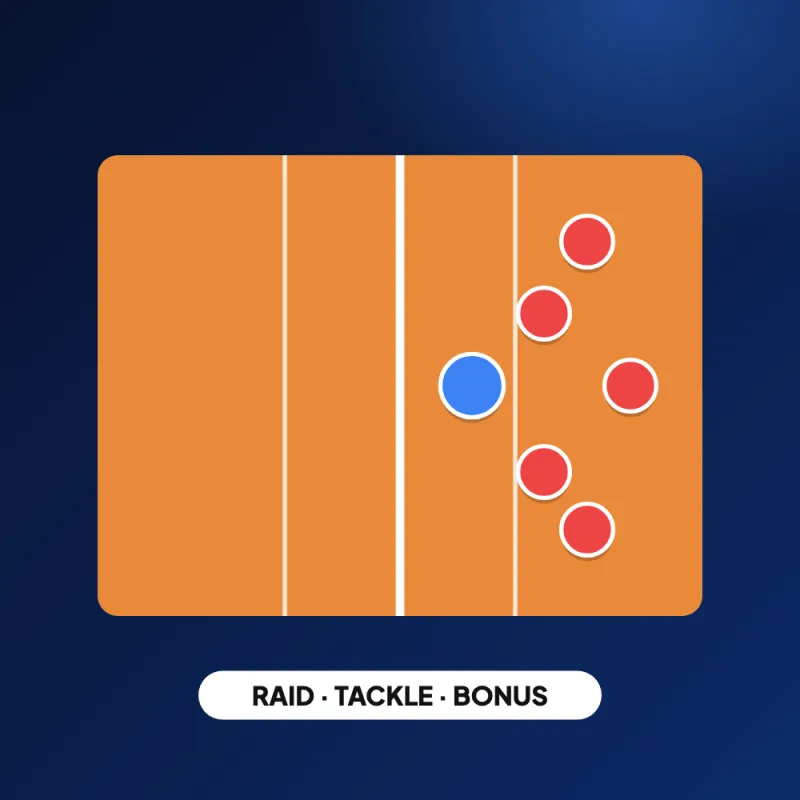
The court and the key lines
For men's matches the playing area measures 13 metres by 10 metres. A few lines decide almost everything that happens in a raid:
- Midline. Divides the court into two halves. A raider who crosses back over it has completed a successful return.
- Baulk line. Runs parallel to the midline inside each half. A raider must cross it with at least one foot, otherwise the raid counts as a failure and the raider is declared out.
- Bonus line. Lies just beyond the baulk line, closer to the end line. A raider who touches the ground beyond it with one foot, while the other foot is in the air, can earn a bonus point.
- Lobbies. Narrow strips along each side of the court. They only become part of the playing area once contact or a struggle has begun between the raider and a defender.
Stepping outside the boundary is costly. A player who goes out of bounds without a struggle in progress is declared out, which is why defenders are taught to hold their positions carefully.
How raiding works
A raid begins when the raider crosses the midline. In the Pro Kabaddi League each raid has a 30-second time limit. Traditionally the raider also had to chant the word "kabaddi" continuously on a single breath, known as the cant; the professional league replaced this with the timed raid.
The raider scores one point for each defender touched before returning to their own half. Those defenders are then out and must leave the court. A touch can be made with any part of the body, including a hand, a foot or a kick, which is why raiders combine sudden lunges with toe touches and backward kicks.
There are three common outcomes of a raid:
- Successful raid. The raider touches one or more defenders, or earns a bonus point, and returns to their half.
- Empty raid. The raider returns without scoring and without being caught. No points are awarded to either team.
- Unsuccessful raid. The raider is tackled and held, steps out of bounds, or fails to cross the baulk line. The raider is out, and the defending side earns a point.
A raid that earns three or more points is often called a super raid. These moments can swing a close match in a few seconds.
The bonus point
The bonus line exists to stop defenders from simply crowding at the back of the court. A raider earns a bonus point by placing one foot beyond the bonus line while the trailing foot is off the ground.
There is an important condition. The bonus is only available when the defending side has at least six players on court. Once the defence has been reduced to five or fewer, raiders must earn their points through touches.
A bonus point does not put any defender out. A raider can, however, earn a bonus and touch defenders in the same raid, collecting both.
How defending works
Defence in kabaddi is a team effort. Defenders link up in chains, with players holding hands, and try to trap the raider so they cannot return to the midline. Common techniques include the ankle hold, the thigh hold, the waist hold and the dash, where a defender pushes the raider out of the court.
A successful stop of the raider is called a tackle, and it earns the defending side one point. Timing matters more than strength. A defender who moves too early and misses gives the raider an easy touch, and the defending team loses that player.
The super tackle rewards a short-handed defence. If the defending side has three or fewer players on court and tackles the raider, it earns two points instead of one. This is a deliberate rule to keep weakened teams in the contest.
Revival, the all out and the do-or-die raid
Players who are out are not gone for good. Kabaddi uses a revival system: each time your team puts an opponent out, one of your own players who is out comes back onto court, in the order in which they went out.
If one team manages to put out every player on the other side, it inflicts an all out. The team that did so receives two extra points, and the side that was all out brings all seven players back onto the court. All outs are usually the biggest scoring swings in a match.
The do-or-die raid prevents teams from wasting time with safe, empty raids. If a team makes two consecutive empty raids, its third raid must score a point. If the raider fails to score, they are declared out. This forces attacking intent even when a team is protecting a lead.
Match length and scoring a result
A Pro Kabaddi League match consists of two halves of 20 minutes with a short interval between them, and teams switch sides at half-time. Each team names a squad of twelve, with seven players on court and the rest available as substitutes.
The team with more points at the end wins. League matches can finish as a tie. In knockout matches a winner is required, and a tie-break procedure based on a set number of raids per side is used to separate the teams.
The table below summarises the main ways points are scored.
| Event | Points | Awarded to |
|---|---|---|
| Raider touches a defender and returns | 1 per defender | Raiding team |
| Bonus line crossed (six or more defenders on court) | 1 | Raiding team |
| Tackle of the raider | 1 | Defending team |
| Super tackle (three or fewer defenders) | 2 | Defending team |
| All out inflicted | 2 extra | Team that put out the full side |
| Raider fails to cross baulk line or steps out | 1 | Defending team |
How the Pro Kabaddi League is organised
The Pro Kabaddi League was launched in India in 2014 as a city-based franchise competition. It began with eight teams and expanded to twelve in 2017. Each franchise represents a city or region and builds its squad through a player auction, with retention rules that allow teams to keep part of their core between seasons.
The season is divided into a league stage and a playoff stage. In the league stage every team plays the others, typically twice, and earns points in the standings according to the result:
- A win earns 5 points.
- A tie earns 3 points for each team.
- A loss by seven points or fewer earns 1 point.
- A heavier loss earns no points.
The losing bonus is significant. Two teams with the same number of wins can be separated in the table by how many narrow defeats each has kept close. When teams are level on standings points, score difference is used as the main tie-breaker.
The best-placed teams in the league stage advance to the playoffs, where the higher-ranked sides are rewarded with an easier route to the final. The exact playoff structure has been adjusted between seasons, so it is worth checking the format for any given year.
Key points
- Two teams of seven take turns raiding; the raider scores one point per defender touched and must return across the midline.
- The baulk line must be crossed on every raid, and a bonus point is available only when six or more defenders are on court.
- Defenders earn one point for a tackle, or two for a super tackle when three or fewer of them remain.
- Revival brings players back, and an all out earns two extra points and resets the team that was cleared.
- Two consecutive empty raids make the next raid do-or-die.
- In the Pro Kabaddi League table, a win earns 5 points, a tie 3 and a loss by seven or fewer 1.


