
The Indian Premier League is the biggest domestic Twenty20 competition in cricket. It mixes India's best players with leading overseas stars, packs about two months of matches into the calendar, and has a format of its own that can confuse newcomers. This guide explains who the teams are, how the league stage and playoffs work, the main playing rules that set the IPL apart, and how squads are built through the auction.
What the IPL is and how it started
The IPL is run by the Board of Control for Cricket in India (BCCI) and was first played in 2008. Each match is a T20 game: both sides bat for a maximum of 20 overs, and the team with more runs wins. A match normally lasts a little over three hours, which suits evening crowds and makes it possible to play a game almost every day of the season.
The league uses a franchise model: teams are privately owned businesses that represent a city or region, pay their players and earn money from sponsorship, ticketing and a share of central income.
The season usually runs from around late March to late May or early June, with exact dates fixed each year.
The ten teams
The IPL started with eight teams. Two new franchises, Gujarat Titans and Lucknow Super Giants, joined for the 2022 season, taking the total to ten. The current teams are:
- Chennai Super Kings (Chennai)
- Mumbai Indians (Mumbai)
- Kolkata Knight Riders (Kolkata)
- Royal Challengers Bengaluru (Bengaluru), known as Royal Challengers Bangalore until 2024
- Delhi Capitals (Delhi), formerly Delhi Daredevils
- Punjab Kings (Mohali region), formerly Kings XI Punjab
- Rajasthan Royals (Jaipur)
- Sunrisers Hyderabad (Hyderabad)
- Gujarat Titans (Ahmedabad)
- Lucknow Super Giants (Lucknow)
Chennai Super Kings and Mumbai Indians are the most successful sides in the league's history, having each won the title five times by the end of the 2025 season. Several other teams have won it once or more, and the competition has a reputation for being open: a side that finishes near the bottom one year can challenge for the title the next, largely because of the auction system.
Each team plays half of its league games at its home ground. Home advantage matters because pitches vary a great deal, from high-scoring grounds to surfaces that help spin.
How the league stage works
With ten teams, a full double round-robin would need 90 league matches, which is too many for the window available. The IPL solves this with a grouping system that gives each team 14 league games and keeps the total at 70.
Two groups of five. Before the season the ten teams are split into two groups. The groups are used only for scheduling; there is a single league table for all ten teams.
The fixture pattern. Each team plays:
- the four other teams in its own group twice (8 matches),
- one paired team from the other group twice (2 matches),
- the remaining four teams in the other group once (4 matches).
That adds up to 14 matches, seven at home and seven away. Because the cross-group pairings vary, some teams face a slightly harder schedule than others.
Points. A win earns two points. A match with no result, usually because of rain, earns one point for each side. A defeat earns nothing. If the scores are level at the end of a match, there is no shared result: the tie is settled by a Super Over, in which each team bats for one over. If the Super Over is also tied, further Super Overs are played until there is a winner.
Net run rate. When teams finish on the same number of points, they are separated mainly by net run rate. This is the team's average runs scored per over across the season, minus the average runs conceded per over. A big win by a wide margin can therefore be worth more than it first appears, and teams chasing a playoff place sometimes try to finish a run chase quickly to boost their figure.
The playoffs explained
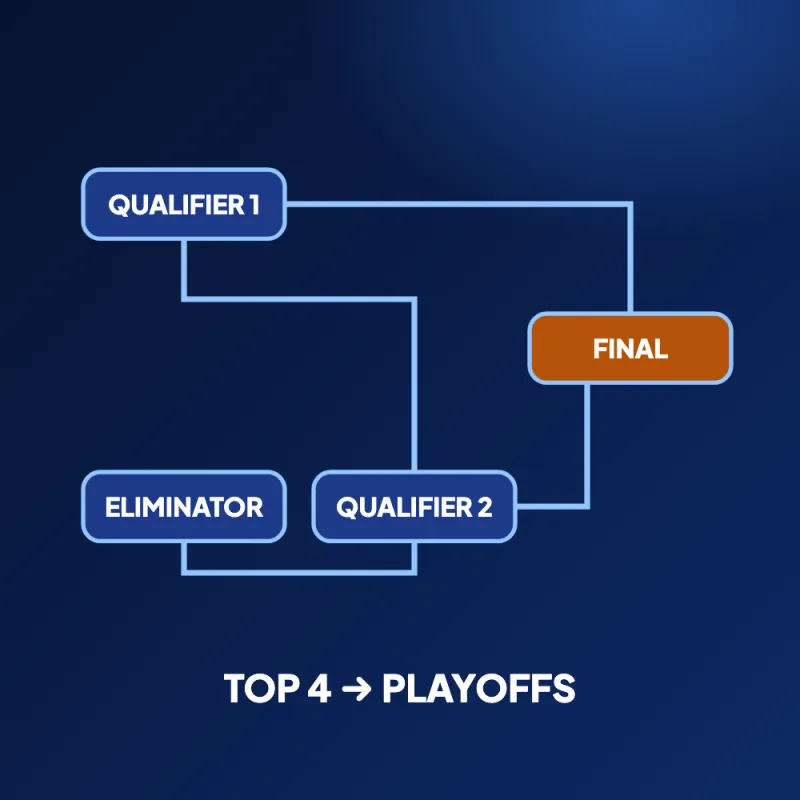
The top four teams in the league table qualify for the playoffs. The IPL does not use a simple semi-final format. Instead it uses a system that rewards finishing in the top two.
| Match | Who plays | What happens next |
|---|---|---|
| Qualifier 1 | 1st v 2nd | Winner goes straight to the final; loser goes to Qualifier 2 |
| Eliminator | 3rd v 4th | Winner goes to Qualifier 2; loser is knocked out |
| Qualifier 2 | Loser of Qualifier 1 v winner of Eliminator | Winner goes to the final; loser is knocked out |
| Final | Winner of Qualifier 1 v winner of Qualifier 2 | Winner is champion |
The practical effect is that the top two teams get two chances to reach the final, while the third and fourth-placed teams must win three knockout matches in a row to lift the trophy. This makes the race for the top two places at the end of the league stage just as important as the race to qualify at all.
Playing rules that make the IPL different
IPL matches follow the standard Laws of Cricket and T20 playing conditions, but the league adds its own rules. These are confirmed before each season and have changed over the years.
Overseas player limit. A team may field no more than four overseas players in its starting XI. This keeps Indian players at the centre of the competition and forces teams to choose their overseas stars carefully, often balancing a top batter against a strike bowler.
The Impact Player rule. Introduced for the 2023 season, this allows each side to name a list of substitutes and bring one of them into the match as an Impact Player, replacing a member of the starting XI. The replaced player takes no further part. In practice, teams use it to add an extra batter when chasing or an extra bowler when defending. The rule has been debated because it reduces the need for genuine all-rounders, and its future is reviewed by the league.
Strategic time-outs. Each innings includes short scheduled breaks that allow captains and coaches to discuss tactics. These are a feature of the IPL rather than of international T20 cricket.
Decision Review System. The IPL uses DRS, so each team can challenge a limited number of on-field umpiring decisions per innings. The league has also used the TV umpire for extra checks, such as calls on wides and no-balls, in some seasons.
How teams are built: auction, retentions and trades
Unlike most football leagues, IPL teams do not simply buy players from one another whenever they like. Squads are built mainly through a player auction held before the season.
Mega and mini auctions. Every few years there is a mega auction, where most players go back into the pool and teams rebuild almost from scratch. In the years between, there is a smaller mini auction where teams fill gaps in their squads. The most recent mega auction was held ahead of the 2025 season.
The purse. Each franchise has a fixed budget, called the purse, which caps how much it can spend on its squad. Every team gets the same purse, which is designed to keep the competition balanced.
Retentions. Before a mega auction, teams may keep a limited number of players from their existing squad. The cost of each retained player is deducted from the purse, so keeping stars means less money to spend at the auction.
Trading window. Between seasons there is a trading window during which franchises can swap players or transfer them for a fee, with the player's agreement.
Squad sizes. Each squad must stay within a minimum and maximum size, with a cap on overseas players. Our separate guide to the IPL auction covers this in detail.
Why the IPL matters to cricket
The IPL has changed the sport in visible ways. It has made T20 cricket a career path for players around the world, accelerated tactics such as aggressive powerplay batting and specialist death bowling, and given young Indian players the chance to share a dressing room with established internationals.
Many newer T20 competitions, including the Bangladesh Premier League, have borrowed its franchise structure and playoff format.
Key points
- The IPL is a T20 franchise league run by the BCCI, first played in 2008.
- Ten teams take part, after Gujarat Titans and Lucknow Super Giants joined in 2022.
- Each team plays 14 league matches, making 70 in total, under a two-group scheduling system with one league table.
- A win is worth two points, a no result one point, and ties are settled by Super Overs; net run rate separates teams level on points.
- The top four reach a playoff system in which the top two get two chances to reach the final.
- A maximum of four overseas players can start, and the Impact Player rule allows one substitute to replace a player during the match.
- Squads are built through auctions, retentions and trades, all within an equal spending purse.


