
Leg before wicket is the most argued-about way of getting out in cricket. It depends on where the ball pitched, where it hit the batter, whether a shot was played and whether it would have gone on to hit the stumps. This guide walks through each of those conditions in plain language, then explains how the Decision Review System (DRS) is used to check LBW calls and what "umpire's call" actually means.
What LBW means
Leg before wicket, usually shortened to LBW, is covered by Law 36 of the Laws of Cricket. In simple terms, a batter can be given out LBW when the ball would have hit the stumps but was stopped by part of the batter's body or equipment other than the bat or the glove holding the bat.
The rule exists to stop batters using their pads to protect the stumps. Without it, a batter could simply stand in front of the wicket and kick every ball away. Despite the name, the ball does not have to hit the leg: a strike on the body, the arm or the helmet can also lead to an LBW decision.
As with any dismissal, the fielding side must appeal. If nobody asks the umpire, the batter cannot be given out.
The conditions for an LBW dismissal
For a batter to be out LBW, all of the following must be true. If any one of them fails, the batter is not out.
- It must be a legal delivery. A batter cannot be out LBW from a no-ball.
- The ball must not pitch outside leg stump. If the ball bounces outside the line of the leg stump, the batter cannot be out LBW, wherever it then hits them. A ball that does not bounce at all, a full toss, passes this test automatically.
- The ball must not touch the bat first. If the ball hits the bat, or the glove holding the bat, before it hits the pad, the batter is not out LBW. If the ball hits bat and pad at the same time, it is treated as hitting the bat first.
- The point of impact must be in line with the stumps, with one exception explained below.
- The ball must have been going on to hit the stumps. The umpire must judge that, had the batter not been in the way, the ball would have struck the wicket.
Hitting the pad first and then the bat does not save the batter.
The "no shot" exception
The fourth condition has an important exception. If the ball strikes the batter outside the line of the off stump, the batter can only be out if they were not genuinely trying to play the ball with the bat.
This is designed to stop a defensive tactic called padding up. Without the exception, a batter could thrust a pad at any ball pitching outside off stump, knowing that an impact outside the line would always be safe. If the umpire decides the batter made no genuine attempt to hit the ball, an impact outside off stump can still lead to an LBW, provided the ball would have gone on to hit the stumps.
If the batter was genuinely playing a shot, an impact outside the line of off stump means not out.
The exception applies only on the off side. An impact outside the line of leg stump is never out, shot or no shot.
Why LBW is so hard to judge
The on-field umpire has a fraction of a second to judge several things at once: where the ball pitched, whether it touched the bat, where it struck the batter and whether it would have hit the stumps. The last part is a prediction about something that never happened.
Factors the umpire weighs up include:
- how far down the pitch the batter was standing when hit, since a long stride makes the prediction harder,
- how much the ball was spinning or moving off the seam,
- the bounce of the pitch, as a ball can pass over the stumps on a bouncy surface,
- whether the batter's front leg hid the ball's path from the umpire's view.
Because of this uncertainty, the traditional view was that any reasonable doubt should go in the batter's favour. Technology has changed how those doubts are resolved, but the principle of respecting the on-field umpire's judgement remains part of the system.
How DRS works
The Decision Review System allows a team to challenge an on-field decision and have it checked by the third umpire using television replays and technology. It was trialled in Test cricket in 2008 and introduced officially by the ICC in 2009. It is now used in Tests, One-Day Internationals and T20 Internationals, as well as in many franchise leagues, although the number of reviews and the technology available are set by the playing conditions for each competition.
Asking for a review. The fielding captain, or the batter who has been given out, signals a review by making a "T" shape with their arms. The request must be made within a short time limit, about 15 seconds after the ball becomes dead. A batter may consult their partner at the other end, but not the dressing room.
Limited reviews. Each team has a limited number of unsuccessful reviews per innings. If a review is successful, the team keeps it. If it fails, the team loses it. This encourages players to review only when they are fairly sure the umpire has made a mistake.
The technology. For an LBW review, the third umpire usually checks:
- slow-motion replays and the front-foot line, to confirm it was a legal delivery,
- edge-detection technology, which uses sound and replay to show whether the ball touched the bat before the pad,
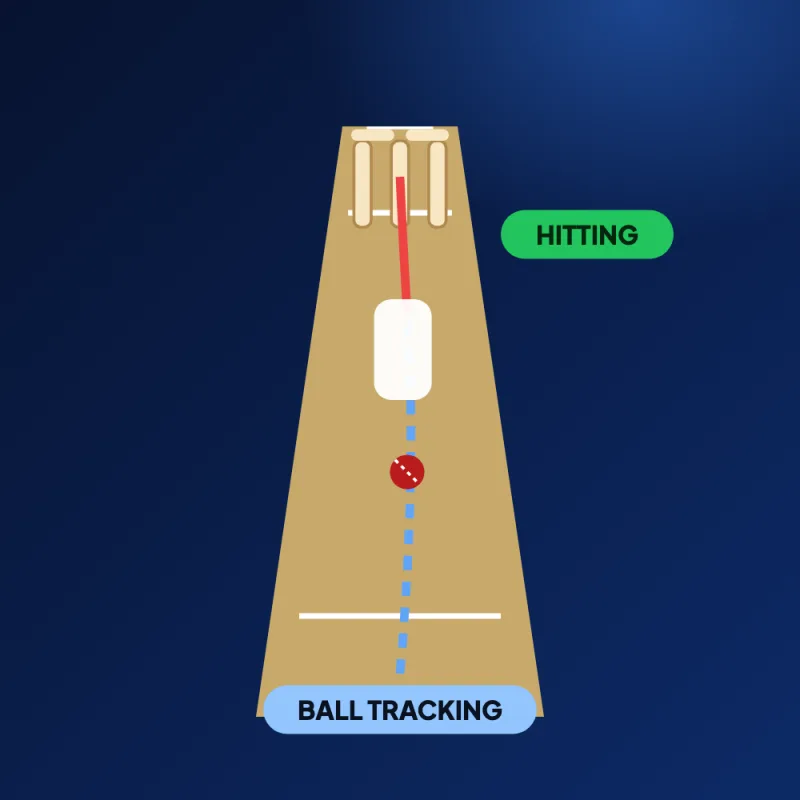
- ball tracking, which reconstructs the path of the ball and predicts where it would have gone after hitting the batter.
Ball tracking shows three key pieces of information: where the ball pitched, where it struck the batter and whether it would have hit the stumps.
Umpire's call explained
"Umpire's call" is the part of DRS that confuses spectators most. It exists because ball tracking is a prediction with a small margin of error, and the system is designed to overturn only clear mistakes.
In practice, it works like this. If the technology shows that a key part of the decision is very close, the original on-field decision stands. This applies to two of the LBW tests:
- Impact. If the point of impact is marginally in line, with only part of the ball inside the line of the stumps, the on-field decision stands.
- Wickets. If the ball is shown to be only clipping the stumps or bails, rather than hitting them firmly, the on-field decision stands.
Under current ICC playing conditions, a not-out decision is overturned to out only if at least half of the ball is shown to be hitting within the zone covered by the stumps, which extends to the top of the bails. If the ball is touching that zone but less than half of it is inside, the umpire's original call stands, whichever way it went. Only if the ball misses the zone completely is an out decision overturned to not out.
This means the same delivery can produce different outcomes depending on the umpire's original decision. A ball clipping the top of the bails stays out if the umpire gave it out, and stays not out if the umpire gave it not out. Many people see this as a fair compromise; others would prefer technology to decide every case outright.
Importantly, a review that ends in umpire's call does not count as unsuccessful, so the team keeps that review.
Common LBW questions
Can you be out LBW to a full toss? Yes. A full toss does not pitch, so it cannot pitch outside leg stump, and the other conditions apply as normal.
Can you be out LBW if you are hit outside the line of off stump? Only if you were not genuinely trying to play the ball with the bat.
Can you be out LBW off a no-ball? No.
Does the batter have to be in front of the stumps? The batter's body does not need to be directly in front, but the point of impact must be in line with the stumps, except under the no-shot exception.
Key points
- LBW is covered by Law 36 and requires an appeal from the fielding side.
- The ball must not pitch outside leg stump, must not hit the bat first and must have been going on to hit the stumps.
- Impact must be in line with the stumps, unless the batter offered no genuine shot to a ball striking them outside off stump.
- DRS lets teams challenge decisions using replays, edge detection and ball tracking, with a limited number of unsuccessful reviews.
- "Umpire's call" keeps the on-field decision when the technology shows a marginal case, and the team keeps its review.


