
Cricket commentators talk about slips, gully, cover and fine leg as if everyone knows where they are, but the names can confuse new fans. This guide explains how the field is divided, where each main position sits, why captains choose attacking or defensive fields, and which rules limit where fielders can stand.
How the field is divided
A cricket team has eleven players on the field. One is the bowler and one is the wicketkeeper, which leaves nine fielders for the captain to place. Almost every fielding name describes a location relative to the batter on strike, so the first thing to understand is how the ground is split.
Off side and leg side. Imagine a line running down the middle of the pitch and out to both ends of the ground. For a right-handed batter, the half of the field in front of their body as they take their stance is the off side, and the half behind their legs is the leg side, also called the on side. For a left-handed batter the two halves swap, which is why fielders often move when a right-hander and a left-hander rotate the strike.
In front of and behind square. A second imaginary line runs across the ground through the batter's position, at right angles to the pitch. Positions in front of this line are "in front of square", and those behind it, towards the wicketkeeper, are "behind square". A position level with the batter is described as "square".
Distance from the bat. Fielders can stand very close, in the middle distance, or out on the boundary. Close catchers are often called "short" or "silly", while boundary riders are described as "deep" or "long".
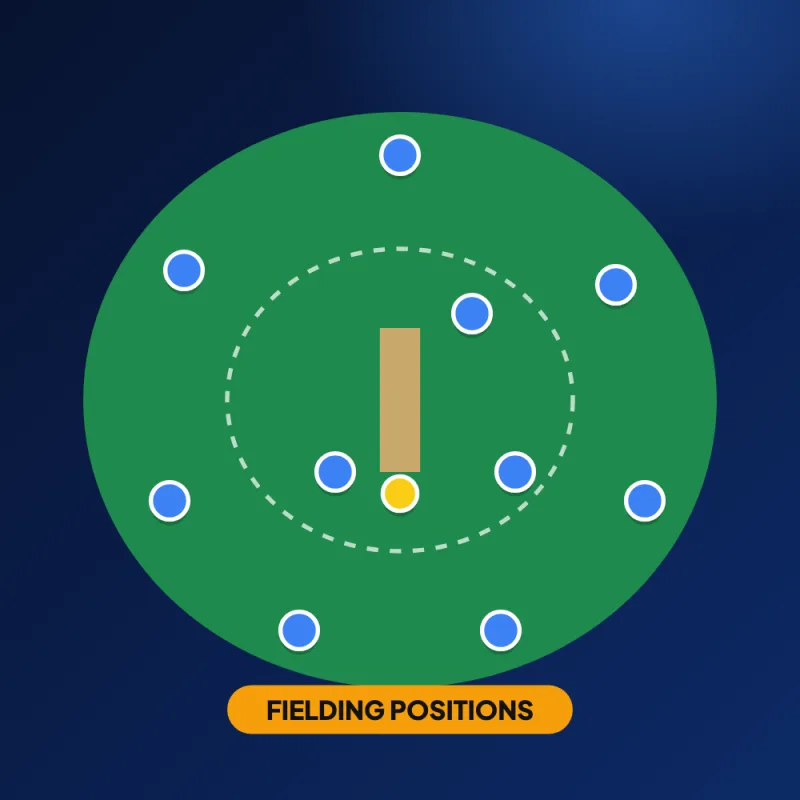
The vocabulary of fielding names
Most positions are built from a few modifiers attached to a base name. Once you know the modifiers, you can locate almost any position you hear described.
- Fine means closer to the line of the pitch behind the batter, so fine leg is nearer the wicketkeeper than square leg.
- Square means close to the line running across the ground through the batter.
- Short means nearer the batter than the standard position, as in short leg or short cover.
- Silly means extremely close, usually within a few metres of the bat, as in silly point and silly mid-off.
- Deep or long means near the boundary, as in deep square leg or long-on.
- Wide and straight describe whether a fielder is angled away from or closer to the line of the stumps.
Close catching positions
These fielders are there to take catches from edges and defensive shots. They are most common in Test cricket and at the start of an innings, when the ball is new and swinging.
Wicketkeeper. The keeper stands behind the stumps, either well back for fast bowling or right up close for spin. They are the only fielder allowed to wear gloves and external leg guards.
Slips. The slips stand in a line on the off side, beside the wicketkeeper, to catch outside edges. They are numbered from the keeper outwards: first slip, second slip, third slip and occasionally fourth slip.
Gully. Gully stands further round on the off side, between the slips and point, to catch thicker edges and mistimed cuts that fly squarer than the slips.
Short leg and silly point. These are the bravest positions in the game. Short leg crouches a few metres from the bat on the leg side, and silly point stands just as close on the off side. Both are used mainly against spin bowling to catch bat-pad deflections. Fielders in these spots almost always wear a helmet and shin protection.
Leg slip and leg gully. These are the leg-side mirror images of slip and gully, used when the bowler is targeting the batter's body or when a spinner is turning the ball sharply into a right-hander.
Ring positions in the inner field
The inner ring is where fielders save singles and stop drives and pushes. Starting from the off side and moving round in front of the batter, the main positions are:
- Point, square on the off side, which stops cuts and square drives. Backward point sits a little behind square.
- Cover point and cover, in front of square on the off side, where many of the best fielders are placed because so many drives go there.
- Extra cover, between cover and mid-off.
- Mid-off, fairly straight on the off side, near the bowler's end.
- Mid-on, the matching position on the leg side.
- Midwicket, on the leg side between mid-on and square leg, which collects flicks and pulls.
- Square leg, level with the batter on the leg side, close to where the second umpire stands.
Boundary positions
Deep fielders stop boundaries and take catches from lofted shots. Their names usually match the inner positions with "deep" or "long" in front.
- Third man guards the off-side boundary behind square, collecting edges and late cuts that beat the slips.
- Deep point and deep cover patrol the off-side boundary. In limited-overs cricket a fielder covering this area is often called the sweeper.
- Long-off and long-on stand on the boundary straight behind the bowler, on either side of the sight screen.
- Deep midwicket covers the area where batters hit many of their big leg-side shots. The region between long-on and deep midwicket is informally known as cow corner.
- Deep square leg and fine leg guard the leg-side boundary for pulls, hooks and glances. Long leg is another name for a deep fine leg.
Attacking and defensive fields
Where a captain places the nine fielders depends on the match situation, the bowler and the batter.
Attacking fields. An attacking field puts several players in catching positions, such as three slips, a gully and a short leg. It gives up easy runs in return for more chances to take wickets. Captains use it with a new ball, when a fresh batter arrives, or when the bowling side has plenty of runs to defend.
Defensive fields. A defensive field moves players back towards the boundary to cut off fours and sixes. It is typical at the end of a limited-overs innings, when batters are trying to score quickly. The trade-off is that singles become easy and fewer catches are on offer close to the bat.
Bowler-specific fields. A fast bowler swinging the ball away from a right-hander will want slips and a gully. An off-spinner turning the ball into a right-hander may prefer a short leg, a leg slip and a fielder at midwicket.
Rules that limit field placements
The Laws of Cricket and the playing conditions for each format restrict where fielders can stand.
Leg-side limit. At the moment the ball is bowled, no more than two fielders, not counting the wicketkeeper, may be behind square on the leg side. This rule was introduced after the 1932-33 "Bodyline" series, when England packed the leg side and bowled short at the batter's body.
The fielding circle. In one-day internationals and T20 cricket, an oval is marked about 30 yards (roughly 27 metres) from the pitch. Playing conditions limit how many fielders may be outside it during different phases. In ODIs, only two fielders may be outside the circle in the first ten overs, up to four from overs 11 to 40, and up to five in the final ten overs. In T20 internationals, only two may be outside during the six-over powerplay, rising to five afterwards.
Close fielders and the pitch. Fielders may not stand on or reach over the pitch before the ball has reached the bat or passed it, and breaking this rule, like breaking the leg-side limit, results in a no-ball. Fielders are also not allowed to move significantly once the bowler starts running in, apart from small adjustments or natural movement towards the batter; if they do, the umpire can call dead ball.
The helmet penalty. Close fielders often leave a spare helmet on the ground behind the wicketkeeper. If the ball strikes it, the batting side is awarded five penalty runs.
| Format | Phase | Maximum fielders outside the circle |
|---|---|---|
| ODI | Overs 1-10 | 2 |
| ODI | Overs 11-40 | 4 |
| ODI | Overs 41-50 | 5 |
| T20I | Overs 1-6 | 2 |
| T20I | Overs 7-20 | 5 |
Key points
- Fielding names describe a position relative to the batter: off side or leg side, in front of or behind square, close or deep.
- Modifiers such as fine, square, short, silly, deep and long combine with base names to locate any fielder.
- Slips, gully, short leg and silly point are catching positions; the boundary positions mainly save runs.
- Attacking fields chase wickets, while defensive fields cut off boundaries and concede singles.
- No more than two fielders may stand behind square on the leg side, and limited-overs cricket adds fielding-circle restrictions.


