
Team sheets and pre-match graphics describe line-ups with numbers like 4-4-2 or 4-3-3, but those numbers only tell part of the story. This guide explains how formations are written, what the most common shapes are designed to do, how they change during a match, and how tactical thinking has evolved over more than a century.
How to read a formation
A formation describes how a team's ten outfield players are arranged. The goalkeeper is always left out of the numbers, which are read from defence to attack. In a 4-4-2, there are four defenders, four midfielders and two forwards. The numbers always add up to ten.
Some formations use three or four numbers to show more detail. A 4-2-3-1 splits the midfield into two deeper players and three more attacking ones, with a single striker ahead of them. A 4-1-4-1 places one holding midfielder in front of the defence, with four players across midfield and one forward.
A formation is a starting point. Numbers describe a team's basic shape, usually when it is defending or when play restarts. Once the ball is moving, players shift constantly. A full-back may push forward into midfield, a winger may drop back to defend, and a midfielder may join the attack. Coaches often describe a team's shape "in possession" and "out of possession" separately for this reason.
The 4-4-2
The 4-4-2 was the standard formation in English football for decades and remains common at many levels. It uses two banks of four, a back four and a midfield four, with two strikers working as a pair.
Strengths. It is simple to organise and covers the width of the pitch well. The two flat lines make it hard for opponents to find space between them, and a strike partnership gives a team two players in the penalty area for crosses. A classic pairing combines a target forward with a quicker partner who runs off them.
Weaknesses. With only two central midfielders, a 4-4-2 can be outnumbered in the middle of the pitch by teams using three. Opponents who place a player in the space between the midfield and defence can be difficult to pick up.
A variation is the diamond 4-4-2, in which the midfield four form a diamond shape with a holding player at the base and a playmaker at the tip. It gives more central control but less natural width.
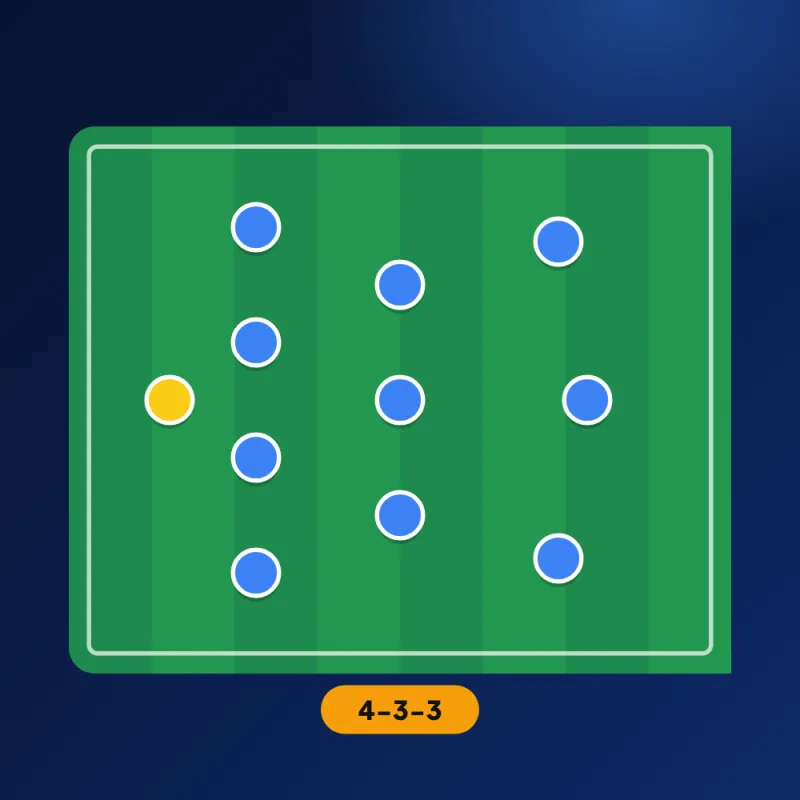
The 4-3-3
The 4-3-3 uses a back four, three central midfielders and three forwards: a central striker with a wide forward on each side. It is closely associated with possession-based football, including the Dutch "Total Football" of the 1970s and many leading club sides since.
Strengths. Three central midfielders help a team control the ball and the centre of the pitch. The wide forwards stretch the opposition and can press defenders high up the pitch. Many modern sides use inverted wingers, playing on the opposite side to their stronger foot so they can cut inside to shoot.
Weaknesses. When the wide forwards stay high, the full-backs can be left exposed on the flanks. The system also demands fit, disciplined midfielders who can cover a lot of ground.
The 4-2-3-1
The 4-2-3-1 became one of the most widely used formations in the 2000s and 2010s. Two holding midfielders, often called a "double pivot", screen the back four. Ahead of them are an attacking midfielder in the centre, usually called the number 10, and two wide players, with one striker at the top.
Strengths. The double pivot gives defensive security, while the three attacking midfielders offer creativity and support for the striker. The shape converts easily into a 4-4-1-1 or 4-5-1 when defending, which makes it flexible.
Weaknesses. The lone striker can become isolated if the attacking midfielders do not get forward quickly. It also relies heavily on the player in the number 10 role to link play.
Back-three systems
Formations with three central defenders have come in and out of fashion. The most common are the 3-5-2 and the 3-4-3, both of which rely heavily on wing-backs, players who cover the whole flank from defence to attack.
The 3-5-2. Three centre-backs, two wing-backs, three central midfielders and two strikers. Argentina's coach Carlos Bilardo used a version of it at the 1986 World Cup, and it was popular in the late 1980s and 1990s. It offers numbers in midfield and a strike partnership.
The 3-4-3. Three centre-backs, two wing-backs, two central midfielders and three forwards. Antonio Conte's Chelsea used it to win the Premier League in the 2016-17 season, which encouraged many other English clubs to experiment with three at the back.
The 5-3-2 and 5-4-1. When the wing-backs drop deep, a back three becomes a back five. These shapes are more defensive and are often used by teams protecting a lead or facing stronger opponents. The difference between a 3-5-2 and a 5-3-2 is usually one of attitude and how high the wing-backs play, rather than a different set of players.
Comparing the main formations
| Formation | Main idea | Common weakness |
|---|---|---|
| 4-4-2 | Two compact banks of four and a strike pair | Can be outnumbered in central midfield |
| 4-3-3 | Midfield control and width from three forwards | Full-backs exposed when wingers stay high |
| 4-2-3-1 | Defensive screen plus a creative number 10 | Lone striker can be isolated |
| 3-5-2 | Extra centre-back and crowded midfield | Wing-backs must cover huge distances |
| 3-4-3 | Three forwards supported by wing-backs | Only two central midfielders |
| 5-3-2 / 5-4-1 | Deep, compact defensive block | Few players available to attack |
How formations evolved
The pyramid. In the late 19th century, teams commonly used a 2-3-5, known as the pyramid, with only two defenders and five forwards. Offside rules at the time required three defending players between an attacker and the goal, which made attacking difficult and suited this shape.
The WM. In 1925, the offside law was changed so that only two defending players were needed. Goals increased, and coaches looked for more defensive security. Herbert Chapman's Arsenal popularised the WM, a 3-2-2-3 shape in which the centre-half dropped back between the full-backs.
Four at the back. Brazil won the 1958 World Cup with a 4-2-4, which helped make the back four standard. England won the 1966 World Cup under Alf Ramsey with a system often described as a 4-4-2 or 4-1-3-2, nicknamed the "wingless wonders" because it did without traditional wingers.
Catenaccio and Total Football. In the 1960s, Italian clubs such as Helenio Herrera's Inter used catenaccio, a defensive system built around a sweeper, or libero, behind the main defensive line. In the 1970s, Rinus Michels's Netherlands, led by Johan Cruyff, played Total Football from a 4-3-3 base, with players constantly swapping positions.
The modern game. Today, formations matter less than principles such as pressing, positional play and transitions between attack and defence. Teams often change shape several times in a match, and many players are expected to perform more than one role.
Key points
- Formations list outfield players from defence to attack and always add up to ten.
- A formation is a starting shape; teams look different with and without the ball.
- 4-4-2 is compact and simple, 4-3-3 favours control and width, and 4-2-3-1 balances defence with creativity.
- Back-three systems rely on wing-backs and can shift between attacking and defensive versions.
- Tactics evolved from the 2-3-5 pyramid through the WM and the back four to today's fluid systems.


