
Offside is the rule most often argued about in football, yet its core idea is simple. This guide explains what an offside position is, when being in that position becomes an offence, the situations where offside cannot apply, and how referees and technology judge it, with clear examples throughout.
Why the offside rule exists
Without offside, an attacker could stand next to the opposition goalkeeper all match and wait for a long ball. The offside rule stops this by requiring attackers to stay level with or behind the defending line until the ball is played to them.
The rule is set out in Law 11 of the Laws of the Game, which are written by the International Football Association Board (IFAB) and apply to football worldwide.
The most important thing to understand is that the law has two separate parts. First, is the player in an offside position? Second, if so, are they involved in active play at the moment a team-mate plays the ball? Only when both are true is there an offence.
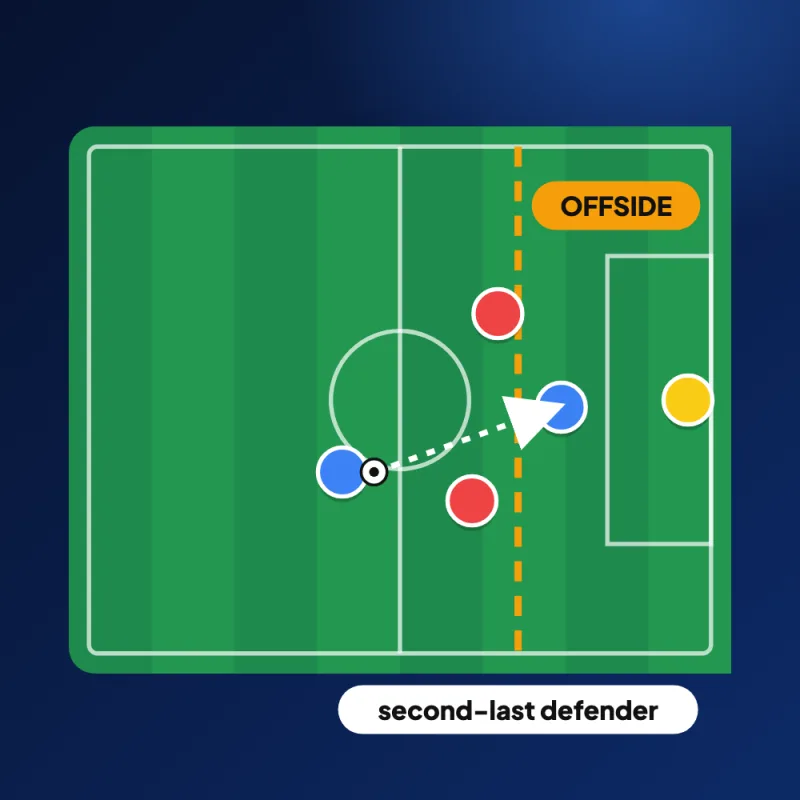
What is an offside position?
A player is in an offside position if, at the moment the ball is played by a team-mate, all of the following apply:
- Any part of their head, body or feet is in the opponents' half of the pitch (the halfway line itself does not count as the opponents' half).
- That part of their body is nearer to the opponents' goal line than the ball.
- It is also nearer to the opponents' goal line than the second-last opponent.
The second-last opponent. This phrase confuses many people. The last opponent is usually the goalkeeper, so the second-last opponent is usually the last outfield defender. But the law simply counts opponents; if the goalkeeper has come out and only one defender is behind them, that defender is the last opponent and the goalkeeper becomes the second-last.
Level is onside. A player who is level with the second-last opponent, or level with the ball, is not in an offside position.
Arms do not count. When judging position, the hands and arms of all players, including goalkeepers, are not considered. The law defines the upper boundary of the arm as the bottom of the armpit. So a striker whose arm is ahead of the defender but whose shoulder is level is onside. The parts that count are those a player can legally score with.
Own half is always safe. A player cannot be in an offside position while in their own half, however far forward their team-mates or opponents are.
Being offside is not an offence by itself
Standing in an offside position is not against the rules. A winger can drift offside on the far side of the pitch for a whole move and nothing happens, provided they do not get involved. The offence occurs only if the player becomes involved in active play. Law 11 describes three ways this happens:
- Interfering with play – playing or touching the ball passed or touched by a team-mate.
- Interfering with an opponent – for example, blocking the goalkeeper's line of sight, challenging an opponent for the ball, clearly attempting to play a ball that is close to them when this affects an opponent, or making an obvious action that clearly impacts an opponent's ability to play the ball.
- Gaining an advantage – playing the ball or interfering with an opponent after the ball has rebounded or been deflected off the goalpost, crossbar, match official or an opponent, or after it has been deliberately saved by an opponent.
The timing is crucial. Offside position is judged at the moment the ball is played or touched by a team-mate, not when the player receives it. A striker who is level when the pass is made and then sprints past the defender to collect the ball is onside, even though they are well beyond the defence by the time they touch it.
When offside cannot apply
There is no offside offence if a player receives the ball directly from:
- a goal kick
- a throw-in
- a corner kick
This is why attackers can stand beside the goalkeeper at a corner. Note the word "directly": if the ball is then played on by a team-mate, offside is judged again from that new moment.
Deliberate play by a defender. If an opponent deliberately plays the ball, for example with a controlled pass or a misjudged attempt to clear it, an attacker who was in an offside position is generally no longer penalised for receiving it. The defender's deliberate play effectively resets the situation. There is an exception: a deliberate save by a defender or goalkeeper does not reset offside. A player who was offside when the shot was taken and then scores the rebound from a save is still penalised.
Worked examples
Example one: the through ball
A midfielder plays a pass between two centre-backs. At the moment the pass is made, the striker's leading foot is half a metre beyond the last defender. The striker runs on and scores. This is offside: the striker was in an offside position when the ball was played and then played the ball.
Example two: the late run
Same pass, but this time the striker is level with the last defender at the moment it is played, then accelerates clear and scores. This is onside. Where the striker is when receiving the ball does not matter.
Example three: the screen on the goalkeeper
A player stands in an offside position directly in front of the goalkeeper while a team-mate shoots from 20 metres. The shooter scores without the offside player touching the ball. This is usually offside, because the player blocked the goalkeeper's line of sight and so interfered with an opponent.
Example four: the far-post bystander
A forward is in an offside position near the far post, well away from the ball and not in the goalkeeper's eyeline, while a team-mate scores from the edge of the area. This is not an offence; the forward did not interfere with play or with an opponent.
Example five: the rebound
A shot hits the post and bounces out to a player who was in an offside position when the shot was struck. That player scores. This is offside: they gained an advantage from a rebound off the goal frame.
Punishment and how officials judge offside
The punishment
When an offside offence is given, the referee awards an indirect free kick to the defending team, taken from the place where the offence occurred. That is where the offside player became involved in play, which may be in their own half if they had run back. Offside is not a misconduct offence, so no card is given for it alone.
The assistant referee. Offside is mainly judged by the assistant referees running the touchlines. They try to stay in line with the second-last defender so they can see the attacker's position at the moment the ball is played. This is difficult, because the passer and receiver may be many metres apart.
Delayed flags. In competitions that use video assistant referees, assistants are commonly told to keep the flag down in tight situations when a clear attacking chance is developing, then signal once the move ends. The reason is practical: a goal wrongly disallowed by an early whistle cannot be restored, but a goal that should not stand can be ruled out after a video check.
Video review and technology. Where VAR is used, offside in the build-up to a goal is checked. Some top competitions also use semi-automated offside technology, which tracks player positions with cameras to help officials draw the lines more quickly and consistently. The law itself is unchanged by technology; it only affects how precisely the moment and positions are measured.
Common myths
- "You can't be offside if the ball goes backwards." Partly true. A player behind the ball when it is played is not in an offside position, which is why cut-backs are usually safe.
- "Any part of the body counts." Not quite. Hands and arms are ignored.
- "Being offside is always a foul." No. An offside position only becomes an offence when the player gets involved.
- "There's no offside from a free kick." False. Offside does apply to free kicks; it is only goal kicks, throw-ins and corner kicks that are exempt.
Key points
- Offside is covered by Law 11 and has two parts: position and involvement.
- A player is in an offside position if any scoring part of the body is in the opponents' half and beyond both the ball and the second-last opponent.
- Level is onside, and hands and arms are not considered.
- Position is judged when a team-mate plays the ball, not when the player receives it.
- There is no offside directly from a goal kick, throw-in or corner kick.
- The punishment is an indirect free kick from where the offence happened.


