
From the 2024-25 season the UEFA Champions League dropped the familiar eight groups of four and replaced them with a single 36-team league phase. This guide explains how the league phase works, how opponents are chosen, what each finishing position means and why UEFA made the change.
What changed and why
For roughly two decades the Champions League began with a group stage: 32 clubs split into eight groups of four, each playing the other three home and away. The top two in each group reached the round of 16, the third-placed team dropped into the Europa League and the fourth-placed team went out of Europe altogether.
That system was simple, but it had well-known weaknesses. Groups were often settled with a round or two to spare, which produced a lot of matches with little riding on them. Big clubs could also meet the same few opponents season after season.
The new idea is one big table. Instead of eight small groups, all 36 clubs sit in a single league standing. Each club plays eight matches against eight different opponents, and every result moves teams up or down the same table. UEFA's aim was more varied fixtures, more meaningful matches late in the phase and a larger competition, with four more clubs than before.
How the league phase works
The league phase is the first stage of the competition proper, after the qualifying rounds. Its key features are:
- 36 clubs take part, up from 32 in the old group stage.
- Each club plays eight matches, four at home and four away.
- Each club faces eight different opponents, and plays each of them only once.
- Points are awarded in the normal way: three for a win, one for a draw and none for a defeat.
- All 36 clubs are ranked in one table.
Because no two clubs play exactly the same set of opponents, the table is not perfectly balanced in the way a full round-robin league is. That is a deliberate trade-off. A full round-robin among 36 teams would need 35 matches each, which is impossible in a European calendar, so the format uses a carefully seeded sample of opponents instead.
The league phase contains 144 matches in total (36 clubs multiplied by eight matches, divided by two because each match involves two clubs). Including the knockout rounds, the competition grew from 125 matches under the old format to 189 under the new one.
How opponents are drawn
Before the league phase, the 36 clubs are divided into four pots of nine. Pot 1 contains the title holders and the highest-ranked clubs, with the remaining pots filled mainly according to UEFA's club coefficient rankings, which reflect recent results in European competition.
Each club is then drawn against two opponents from each pot, one at home and one away. A club from Pot 1, for example, plays two other Pot 1 clubs, two from Pot 2, two from Pot 3 and two from Pot 4. This keeps each club's schedule broadly comparable in difficulty.
There are also restrictions on who can meet whom:
- Clubs cannot be drawn against teams from their own national association in the league phase.
- A club can face a maximum of two opponents from any single other country.
Working out a valid set of fixtures for 36 clubs under all of these constraints is too complex to do with balls and bowls alone, so UEFA uses automated software as part of the draw. Clubs are revealed with their opponents, and the dates and kick-off times are confirmed afterwards.
What each league position means
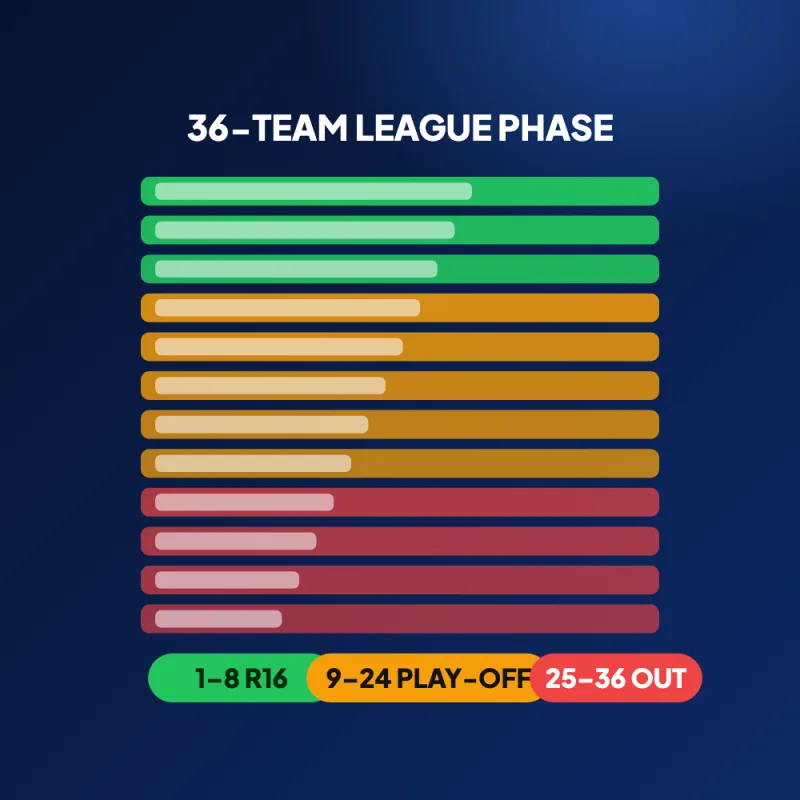
The final table after eight rounds decides every club's fate. It is divided into three bands.
| Final position | Outcome |
|---|---|
| 1st to 8th | Qualify directly for the round of 16 |
| 9th to 24th | Enter the two-legged knockout play-off round |
| 25th to 36th | Eliminated from European competition for the season |
The top eight earn a rest. Clubs finishing in the top eight skip the play-off round, which gives them two fewer matches and a seeded position in the round of 16.
The middle sixteen fight on. Clubs placed 9th to 24th meet in a knockout play-off. In general, the clubs ranked 9th to 16th are seeded and paired with clubs ranked 17th to 24th, and the seeded club plays the second leg at home. The eight winners join the top eight in the round of 16.
The bottom twelve go out. One significant difference from the old system is that there is no longer a safety net. Under the group stage, third-placed teams dropped into the Europa League. Under the new format, clubs finishing 25th or lower are simply eliminated from Europe for that season.
Tiebreakers in the league table
With 36 clubs in one table and only eight matches each, ties on points are common. Because clubs do not all play each other, head-to-head records cannot be the main tiebreaker as they were in the old groups. Instead, UEFA applies a sequence of overall criteria.
The first and most important is goal difference across all league phase matches, followed by goals scored. If clubs are still level, further criteria come into play, such as away goals scored, number of wins and measures based on the strength of the opponents each club faced. The exact order is set out in the competition regulations for each season, so it is worth checking the current rules when a tight finish is being decided.
The practical lesson is that every goal matters. A heavy win early in the league phase can be worth a place or two in the final table, and that can decide whether a club finishes eighth or ninth.
The knockout rounds
From the round of 16 onwards, the competition looks much more familiar. Ties are played over two legs, home and away, until the final, which is a single match at a neutral venue chosen in advance.
If the aggregate score over two legs is level, the tie goes to extra time and, if needed, a penalty shoot-out. The away goals rule, which once separated teams level on aggregate, was abolished in UEFA club competitions from the 2021-22 season and is not part of the new format.
A further change is that the knockout path is shaped by league position. Rather than a completely open draw at every stage, the bracket is structured so that higher-placed clubs are kept apart in the early knockout rounds and receive home advantage in the second leg. Finishing higher in the league phase therefore brings a real reward beyond simply qualifying.
The same model in the Europa League and Conference League
UEFA introduced the league-phase model across all three of its men's club competitions at the same time. The Europa League also has 36 clubs playing eight matches each. The Conference League uses 36 clubs as well, but each club plays six matches rather than eight.
The qualifying bands are the same in principle: the top eight go straight to the round of 16, positions 9 to 24 enter a knockout play-off and the rest are eliminated. Unlike the old system, clubs no longer drop from the Champions League into the Europa League part-way through a season.
Strengths and criticisms
Supporters of the new format point to several benefits:
- A wider range of fixtures, including more meetings between top clubs early in the season.
- More matches with something at stake on the final matchday, because positions around 8th and 24th are often contested.
- Four extra clubs taking part in the main stage.
Critics raise fair points too. Eight matches against different opponents makes the table harder to compare than a traditional group. The extra fixtures add to an already crowded calendar for leading players. Some also argue that with 24 of 36 clubs progressing, a strong club can survive a poor run in the league phase. Whether the balance is right is likely to be debated for years.
Key points
- Since 2024-25 the Champions League has opened with a single 36-team league phase instead of eight groups.
- Each club plays eight matches against eight different opponents, two from each of four seeding pots.
- Places 1 to 8 go straight to the round of 16, places 9 to 24 enter a two-legged play-off and places 25 to 36 are eliminated.
- Goal difference and goals scored are the first tiebreakers, because clubs do not all play each other.
- Knockout ties are two-legged until a single-match final, with no away goals rule.
- The Europa League and Conference League use the same model, with the Conference League playing six league matches.


