
When rain cuts a limited-overs match short, the side batting second rarely gets a simple pro-rata target. Instead, the umpires use the DLS method, a mathematical system that works out a fair target based on the overs and wickets each team had available. This guide explains where the method came from, the idea of "resources" at its heart, how a revised target is calculated, and why it sometimes produces results that look strange at first glance.
What DLS stands for and why it exists
DLS stands for Duckworth-Lewis-Stern. The method was created by two English statisticians, Frank Duckworth and Tony Lewis, and was first used in international cricket in the 1996-97 season. The ICC adopted it as the standard method for rain-affected one-day matches in 2001. Australian statistician Steven Stern later took over its development, and it was renamed Duckworth-Lewis-Stern in 2014.
Before DLS, cricket used simpler rules that often produced unfair results. The most widely remembered example is the 1992 World Cup semi-final between England and South Africa in Sydney. A short rain break, combined with the rule then in use, left South Africa needing 22 runs from one ball. The target had gone from difficult to impossible without South Africa doing anything wrong. That match is often cited as the moment it became clear the sport needed a better approach.
The basic problem. A team batting for 50 overs can build steadily and attack late; a team with only 25 overs can attack from the start. Simply halving the target ignores this.
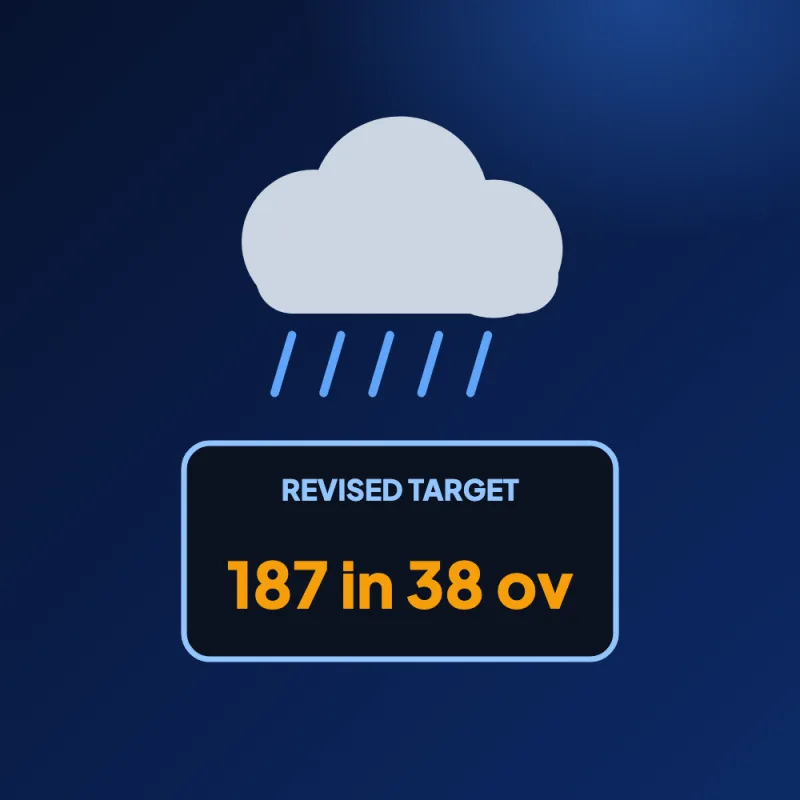
The key idea: resources
DLS is built on a single concept. At any point in an innings, a team has two resources left to score runs with: the overs remaining and the wickets in hand. The method combines these into one figure, expressed as a percentage of the resources available at the start of a full innings.
At the start of a 50-over innings, a team has 100% of its resources. As overs are bowled and wickets fall, that percentage drops. By the end of the innings it reaches zero.
Crucially, the two resources interact. Losing a wicket costs more when lots of overs remain, because the team loses a batter who could have used them. Losing overs costs more when plenty of wickets are left, because those batters can no longer be used to full effect. A team at 200 for 2 after 40 overs has far more scoring power left than a team at 200 for 8 after 40 overs, even though both have ten overs remaining.
The percentages come from studying the scoring patterns of a large number of past matches. They describe how many runs, on average, a team can expect to add from a given position. Those patterns are updated from time to time to reflect the way the modern game is played, with higher scoring rates than in earlier eras.
How a revised target is worked out
Once the resources are known, the calculation is straightforward in principle. The umpires and match officials compare the resources each team had.
Step one. Work out the resources used by Team 1 (the side batting first), taking into account any interruptions to their innings.
Step two. Work out the resources available to Team 2 (the chasing side), based on the overs they will now receive and when any interruptions occur.
Step three. If Team 2 has fewer resources than Team 1, their target is scaled down in proportion. The par score is Team 1's total multiplied by the ratio of Team 2's resources to Team 1's resources. The target to win is the par score plus one run.
Here is a simplified, illustrative example. The resource figure below is chosen to show the method, not taken from the official tables.
- Team 1 bats its full 50 overs and makes 250. It used 100% of its resources.
- Rain arrives before Team 2 starts, and their innings is cut to 40 overs.
- Suppose the tables show that 40 overs with ten wickets in hand is worth 90% of a full innings.
- The par score is 250 × 0.90 = 225. Team 2 needs 226 to win.
Notice that a pure run-rate approach would have set a target of 201 (250 × 40/50, plus one). DLS sets a higher target because Team 2, knowing from the start that they have 40 overs and all ten wickets, can bat more aggressively than a side pacing itself for 50.
When Team 2 has more resources. Sometimes Team 1's innings is the one interrupted, perhaps cut short while they were well set and planning a late surge. In that case Team 2 may end up with more resources than Team 1 had. The method then increases the target above Team 1's actual score, to reflect the runs Team 1 would likely have scored if they had known the innings would be shorter. This is the part of DLS that most often surprises spectators, but it is what makes the method fair to the side batting first.
Par scores during the chase
DLS is not only used to set a target before the chase begins. Throughout the second innings, officials track a par score: the score Team 2 would need at that moment, given wickets lost and overs bowled, to be exactly level with Team 1.
If play is abandoned with no chance of resuming and the minimum number of overs has been bowled, the result is decided by comparing Team 2's actual score with the par score. If they are ahead of par, they win. If they are behind, they lose. If they are exactly on par, the match is a tie.
This is why batters in a chase watch the par score when dark clouds gather. A side slightly ahead may protect wickets, because losing one lifts the par score sharply, while a side behind may need to take risks.
Minimum overs for a result
A rain-affected match cannot be decided by DLS after only a handful of overs. The playing conditions set a minimum number of overs that the side batting second must face before a result is possible.
- In men's and women's One-Day Internationals, the minimum is 20 overs for the side batting second.
- In Twenty20 Internationals, the minimum is 5 overs for the side batting second.
If the minimum cannot be reached, the match is declared a no result. Some tournaments add reserve days for important knockout matches so that a result is still possible after bad weather. Domestic competitions can set their own minimums in their playing conditions.
Standard and Professional editions
There are two versions of the method.
The Standard Edition uses a set of published tables. With these, anyone can work out a revised target with a calculator and the right percentages. It was designed for lower levels of cricket where computers may not be available.
The Professional Edition is a computer program used in international and top-level professional cricket. It uses a more sophisticated model, particularly for high-scoring matches, and the calculations are not published as simple tables. This is why commentators cannot always reproduce an international DLS target in their heads, and why the official target appears on the scoreboard after a short delay.
Common criticisms and alternatives
No rain rule is perfect, and DLS has critics.
T20 cricket. The method was originally designed around the 50-over game. Some players and analysts argue that it does not capture T20 scoring patterns as well, especially in very short chases where a few big hits can change everything. The model has been refined over time to account for this, but debate continues.
Wickets versus overs. Because wickets are so valuable early in a chase, a side that loses two quick wickets just before rain arrives can find itself well behind par, even if its run rate was healthy. Supporters of the method say this is fair, as losing wickets genuinely reduces a team's chances. Critics feel it can be harsh.
Other methods exist. The best known is the VJD method, devised by Indian engineer V. Jayadevan, which has been used in Indian domestic cricket. However, DLS remains the method used in international cricket and in most major professional competitions.
Key points
- DLS (Duckworth-Lewis-Stern) is the standard method for setting targets in rain-affected limited-overs matches.
- It treats overs remaining and wickets in hand as combined "resources", expressed as a percentage of a full innings.
- Team 2's target is Team 1's score scaled by the ratio of resources, plus one run.
- If Team 1's innings was cut short, Team 2's target can be higher than Team 1's actual score.
- A par score is tracked throughout the chase and decides the result if play cannot resume.
- A result needs at least 20 overs for the chasing side in ODIs and 5 overs in T20Is; otherwise it is a no result.
- International cricket uses the computer-based Professional Edition; the Standard Edition uses published tables.


